Blueair Support






Top Questions
Do Blueair air purifiers emit ozone?
All Blueair air purifiers are CARB certified, meaning they are considered safe and do not exceed ozone emission limits. Blueair has conducted ongoing independent testing to ensure that our air purifiers do not release harmful ozone levels. Our units are tested in accordance with UL Standard 867 and demonstrate ozone emission levels far below the mandated California Air Resource Board (CARB) ozone emissions limit of less than 50 parts per billion (ppb).
Tested at Intertek, a CARB-accredited test lab, Blueair products undergo a comprehensive series of tests to measure ozone emissions. In these eight-hour-long tests, air purifiers are tested at high and low speeds – with and without filters installed. The Intertek facility features environmental chamber technology, using trusted and proven scientific methods available for testing to verify if products produce ozone.
Certified air purifiers, including all Blueair air purifiers, are listed on the CARB website.
CARB-certified products are also identified by the CARB text printed on the product packaging:
In 2021, Blueair’s Blue Pure Auto, DustMagnet, HealthProtect, and Pure Fan Auto models also received Zero Ozone Verification, one of the most stringent ozone emissions standards available, by independent testing lab Intertek. Products with this designation meet or exceed all other nationally recognized certification programs, emitting ozone concentrations of 5 parts per billion (ppb) or less. Additional Blueair models are currently also being certified.
Learn more: https://www.intertek.com/sustainability/zero-ozone/
My tVOCs seem too low, why?
Low tVOCs levels can occur for various reasons:
You actually have low tVOC levels in the air.
Your device has recently been restarted (unplugged or after a power cut). In this case, the sensors need a little time to re-adapt. This can take up to one week.
Your device has been turned on and off in environments with different humidity and temperature. If so, the sensor needs a bit of time to re-adapt. This can take up to one week.
I have lost my user manual, what do I do?
To view the user manual for your device, please follow this link https://support.blueair.com/faq/s/?language=en_US select the family that your device is in, and scroll down to the Specifications & Instructions section, then click on the user manual for your corresponding model.
My tVOC levels are high, what should I do?
Your air might be temporarily polluted.
Blueair's tVOC sensors are designed to react to most gases (tVOC = Total Volatile Organic Compounds). The concentration of the gases is summarized into air quality levels in the app. If you see high tVOCs levels, the air is probably temporarily polluted with gaseous pollutants. There can be many sources, such as perfume, new furniture, humidity, repellent, nail varnish, scented candle, disinfectant cleaner, laundry detergent, softener, paints, solvent, varnish, glue, dry-cleaned clothes, air fresheners, etc.
Also, the presence of humans and pets can provoke high tVOC levels (body odors and gasses), which is not harmful to your health. It only means that it is time to ventilate the room!
Here is what you can do to lower the VOC concentrations
Run your air purifier with a Smokestop filter (not suitable with all models of air purifiers).
Open the window and ventilate for at least ten minutes If you still think that your values are strangely high, contact us! We'll help you check that your device is set up correctly.
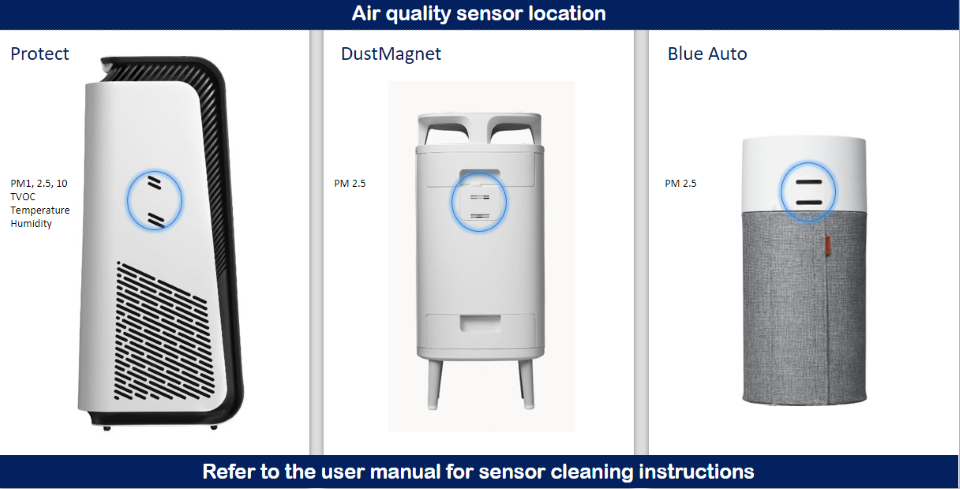
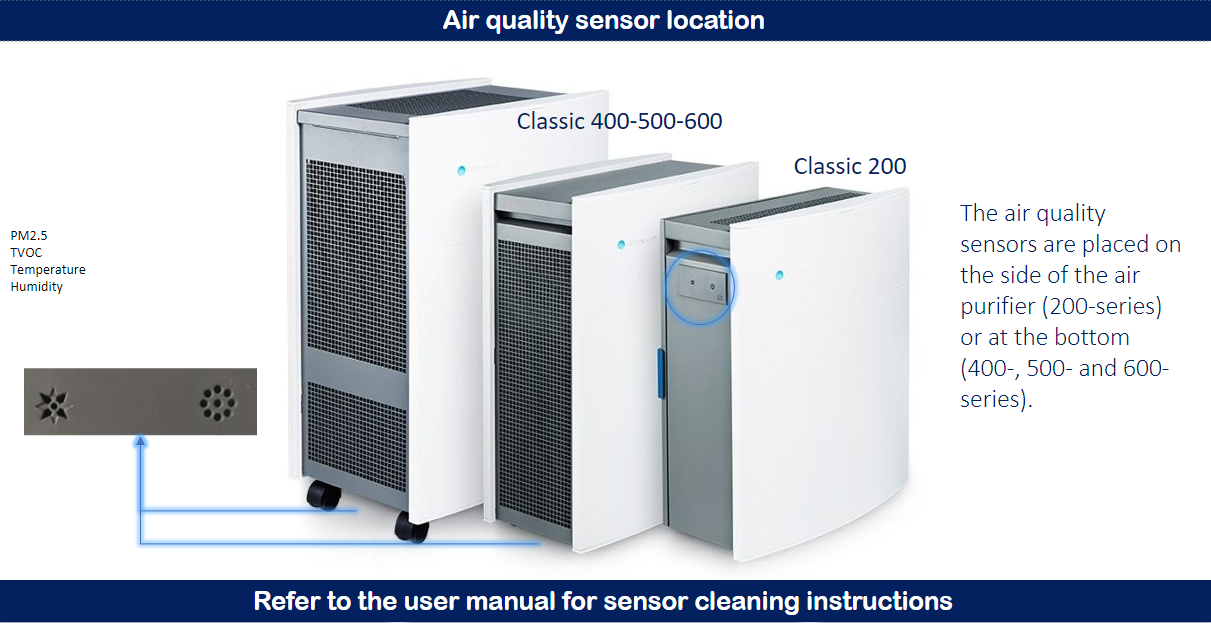
Where are the air quality sensors located on my air purifier?